Demo 2D RL Environment for the PURT Course using Dynamic Programming#
Environment#
State Space#
\(\mathcal{S} \in \mathbb{Z} \cap \left[0,N_{\text{grid}}^2-1\right] \times \mathbb{Z} \cap \left[0,N_{\text{midpoint}}\right]\)
\(N_{\text{grid}}\): Number of grid cells in a single direction (we assume the grid is square)
\(N_{\text{midpoint}}\): Number of midpoints between pylons
\(\mathbb{Z} \cap \left[0,N_{\text{grid}}^2-1\right]\): 2D square grid of size \(N_{\text{grid}} \times N_{\text{grid}}\) compressed into a scalar integer of maximum value \(N_{\text{grid}}^2 - 1\) corresponding to the grid index number
\(\mathbb{Z} \cap \left[0,N_{\text{midpoint}}\right]\): Number of midpoints visited
Observation Space#
\(\mathcal{O} = \mathcal{S}\) (Same as the state space)
Action Space#
\(\mathcal{A} \in \{0,1,2,3\}\)
0: Up
1: Down
2: Left
3: Right
Tranisition Logic#
Move deterministicaly in the direction of action as long as there is room to move and the current cell does not intersect a pylon.
If there is no room to move in the direction of action or if the current cell intersects a pylon, remain stationary and end the episode.
Rewards#
Reached next midpoint in order: \(+1\)
Returned to starting point (endpoint) after going through all midpoints: \(+1\)
Moved to a cell intersecting a pylon: \(-1\)
# Environment imports
import gymnasium as gym
from gymnasium import spaces
import numpy as np
import matplotlib.pyplot as plt
from matplotlib.collections import LineCollection
---------------------------------------------------------------------------
ModuleNotFoundError                       Traceback (most recent call last)
Cell In[1], line 2
      1 # Environment imports
----> 2 import gymnasium as gym
      3 from gymnasium import spaces
      4 import numpy as np

ModuleNotFoundError: No module named 'gymnasium'
# Define the action space as an enum
from enum import Enum

class Action(Enum):
    Right = 0
    Up = 1
    Left = 2
    Down = 3
# Simple PURT Environment
class SimplePURT(gym.Env):
    # PYLON_COORDINATES: Bottom left corner is (0,0), Top right corner is (1,1)
    def __init__(self, GRID_N=10, MAX_STEPS=100, REWARDS={"neutral": 0, "midpoint": 1, "endpoint": 1, "pylon": -1}, NOISE=0, INIT_STATE=np.asarray([0, 0]), PYLON_COORDINATES=np.array([[0.2, 0.2],[0.2,0.8],[0.8,0.8],[0.8,0.2]])):
        super(SimplePURT, self).__init__()

        self.GRID_N = GRID_N
        self.MAX_STEPS = MAX_STEPS
        self.REWARDS = REWARDS
        self.NOISE = NOISE # [0,1] -- 0: No Noise, 1: 100% Noise
        self.INIT_STATE = INIT_STATE.copy()

        self.PYLON_GRID_COORDINATES = np.round(PYLON_COORDINATES * (GRID_N - 1)).astype(int) # Convert pylon coordinates to grid coordinates
        self.PYLON_GRID_INDICES = self.PYLON_GRID_COORDINATES[:, 0] + self.PYLON_GRID_COORDINATES[:, 1] * GRID_N # Convert grid coordinates to grid indices

        self.PYLON_MIDPOINT_COORDINATES = np.zeros_like(PYLON_COORDINATES)
        for i in range(PYLON_COORDINATES.shape[0]):
            self.PYLON_MIDPOINT_COORDINATES[i] = 0.5 * (PYLON_COORDINATES[i] + PYLON_COORDINATES[(i + 1) % PYLON_COORDINATES.shape[0]]) # Midpoint between pylon i and pylon (i+1)
        self.PYLON_MIDPOINT_GRID_COORDINATES = np.round(self.PYLON_MIDPOINT_COORDINATES * (GRID_N - 1)).astype(int) # Convert midpoint coordinates to grid coordinates
        self.PYLON_MIDPOINT_INDICES = self.PYLON_MIDPOINT_GRID_COORDINATES[:, 0] + self.PYLON_MIDPOINT_GRID_COORDINATES[:, 1] * GRID_N # Convert grid coordinates to grid indices

        self.observation_space = spaces.MultiDiscrete([
            GRID_N * GRID_N, # Grid index number
            len(self.PYLON_MIDPOINT_INDICES) + 1 # Number of midpoints visited
        ])
        self.action_space = spaces.Discrete(4) # Action space
        self.state = INIT_STATE.copy() # Initial state
        self.n_steps = 0 # Keep track of the number of steps taken
        self.state_history = [INIT_STATE.copy()] # Keep track of the state history
        self.action_history = [] # Keep track of the action history

    def reset(self):
        self.state = self.INIT_STATE.copy()
        self.n_steps = 0
        self.state_history = [self.state.copy()]
        self.action_history = []
        return self.get_observation(), self.get_info()

    def step(self, action, ignore_truncation=False):
        new_state = self.state.copy()
        reward = self.REWARDS["neutral"]
        done = False
        truncated = False

        # 2D movement
        new_state[0] = self.get_new_position(action)

        # Reward
        if new_state[0] != self.state[0]:
            if new_state[0] in self.PYLON_GRID_INDICES:
                reward += self.REWARDS["pylon"] # Penalty for hitting a pylon
                done = True
            elif new_state[1] < len(self.PYLON_MIDPOINT_INDICES):
                if new_state[0] == self.PYLON_MIDPOINT_INDICES[new_state[1]]:
                    reward += self.REWARDS["midpoint"] # Reward for visiting midpoints in order
                    new_state[1] += 1 # Move to the next midpoint
            elif new_state[0] == self.INIT_STATE[0]:
                reward += self.REWARDS["endpoint"] # Reward for returning to initial state
                done = True
        else:
            done = True # If the agent tries to move out of bounds, end the episode

        self.state = new_state
        self.state_history.append(new_state.copy())
        self.action_history.append(action)

        if not ignore_truncation:
            self.n_steps += 1
            truncated = self.n_steps >= self.MAX_STEPS # Truncate the episode after MAX_STEPS

        return self.get_observation(), reward, done, truncated, self.get_info()

    def get_observation(self):
        return self.state

    def get_info(self):
        return {"state_history": self.state_history, "action_history": self.action_history}

    def get_possible_next_states(self, action):
        # 1. Determine probabilities for noise tendencies
        # Noise = 0 -> prob_intended = 1.0, prob_dev = 0.0
        p_dev = self.NOISE / 3.0
        p_intended = 1.0 - (2.0 * p_dev)

        # Map tendencies (-1: left shift, 0: intended, 1: right shift) to probabilities
        tendencies = [
            (0, p_intended),
            (-1, p_dev),
            (1, p_dev)
        ]

        possible_transitions = {} # Key: (next_position, next_midpoint_count), Value: [prob, reward]

        for tendency, prob in tendencies:
            if prob <= 0:
                continue  # Skip zero-probability transitions

            # Determine effective action based on tendency logic from get_new_position
            transition = Action(action)
            if tendency != 0:
                match transition:
                    case Action.Up:
                        transition = Action.Right if tendency == 1 else Action.Left
                    case Action.Down:
                        transition = Action.Left if tendency == 1 else Action.Right
                    case Action.Left:
                        transition = Action.Up if tendency == 1 else Action.Down
                    case Action.Right:
                        transition = Action.Down if tendency == 1 else Action.Up

            # Compute next grid position index
            curr_pos = self.state[0]
            match transition:
                case Action.Up:
                    new_pos = (curr_pos + self.GRID_N) if curr_pos < self.GRID_N * (self.GRID_N - 1) else curr_pos
                case Action.Down:
                    new_pos = (curr_pos - self.GRID_N) if curr_pos >= self.GRID_N else curr_pos
                case Action.Left:
                    new_pos = (curr_pos - 1) if curr_pos % self.GRID_N != 0 else curr_pos
                case Action.Right:
                    new_pos = (curr_pos + 1) if (curr_pos + 1) % self.GRID_N != 0 else curr_pos

            # Calculate reward and next state logic matching step()
            new_state = self.state.copy()
            reward = self.REWARDS["neutral"]
            done = False

            if new_pos != curr_pos:
                new_state[0] = new_pos
                if new_pos in self.PYLON_GRID_INDICES:
                    reward += self.REWARDS["pylon"]
                    done = True
                elif new_state[1] < len(self.PYLON_MIDPOINT_INDICES):
                    if new_pos == self.PYLON_MIDPOINT_INDICES[new_state[1]]:
                        reward += self.REWARDS["midpoint"]
                        new_state[1] += 1
                elif new_pos == self.INIT_STATE[0]:
                    reward += self.REWARDS["endpoint"]
            else:
                # Out-of-bounds boundary bump
                done = True
                pass

            state_key = (int(new_state[0]), int(new_state[1]))

            # Aggregate probabilities if different noise tendencies lead to identical outcome states
            if state_key in possible_transitions:
                possible_transitions[state_key][0] += prob
            else:
                possible_transitions[state_key] = [prob, reward, done]

        # Convert results into required format [[next_state_array, prob, reward], ...]
        results = []
        for (pos, midpoints_visited), (p, r, d) in possible_transitions.items():
            next_state_arr = np.array([pos, midpoints_visited], dtype=int)
            results.append([next_state_arr, p, r, d])

        return results

    def get_new_position(self, action):
        # 1. Simplify noise sampling (equivalent to your normal ppf logic)
        p_dev = self.NOISE / 3.0
        tendency = np.random.choice([-1, 0, 1], p=[p_dev, 1 - 2 * p_dev, p_dev])

        # 2. Resolve direction shift if noise occurs
        transition = Action(action)
        if tendency != 0:
            match transition:
                case Action.Up:
                    transition = Action.Right if tendency == 1 else Action.Left
                case Action.Down:
                    transition = Action.Left if tendency == 1 else Action.Right
                case Action.Left:
                    transition = Action.Up if tendency == 1 else Action.Down
                case Action.Right:
                    transition = Action.Down if tendency == 1 else Action.Up

        # 3. Calculate grid position with boundary limits
        curr_pos = self.state[0]
        match transition:
            case Action.Up:
                return (curr_pos + self.GRID_N) if curr_pos < self.GRID_N * (self.GRID_N - 1) else curr_pos
            case Action.Down:
                return (curr_pos - self.GRID_N) if curr_pos >= self.GRID_N else curr_pos
            case Action.Left:
                return (curr_pos - 1) if curr_pos % self.GRID_N != 0 else curr_pos
            case Action.Right:
                return (curr_pos + 1) if (curr_pos + 1) % self.GRID_N != 0 else curr_pos

    def render(self, ax=None, title=None, legend_outside=True):
        # 1. Initialize the plot (or draw into a caller-provided axes for side-by-side comparisons)
        standalone = ax is None
        if standalone:
            fig, ax = plt.subplots(figsize=(7, 7))
        ax.set_xlim(-0.5, self.GRID_N - 0.5)
        ax.set_ylim(-0.5, self.GRID_N - 0.5)

        # Configure grid lines to match your matrix index boundary points
        ax.set_xticks(np.arange(self.GRID_N))
        ax.set_yticks(np.arange(self.GRID_N))
        ax.grid(True, which='both', color='gainsboro', linestyle='-', linewidth=0.5)

        # 2. Extract and Plot Pylons (|)
        px = self.PYLON_GRID_COORDINATES[:, 0]
        py = self.PYLON_GRID_COORDINATES[:, 1]
        ax.scatter(px, py, color='firebrick', marker='|', s=250, linewidths=3, label='Pylon')

        # 3. Extract and Plot Midpoints (o)
        mx = self.PYLON_MIDPOINT_GRID_COORDINATES[:, 0]
        my = self.PYLON_MIDPOINT_GRID_COORDINATES[:, 1]
        ax.scatter(mx, my, color='darkorange', marker='o', s=100, facecolors='none', edgecolors='darkorange', linewidths=2, label='Midpoint')

        # 4. Process and Plot Agent Path Line (With Smooth Continuous Gradient)
        if self.state_history:
            path_x = np.array([state[0] % self.GRID_N for state in self.state_history])
            path_y = np.array([state[0] // self.GRID_N for state in self.state_history])

            # --- Continuous Gradient Line Implementation via Interpolation ---
            if len(path_x) > 1:
                # Interpolate 100 fine points between every step to blend colors flawlessly
                num_interp_points = (len(path_x) - 1) * 100
                t_original = np.arange(len(path_x))
                t_fine = np.linspace(0, len(path_x) - 1, num_interp_points)

                fine_x = np.interp(t_fine, t_original, path_x)
                fine_y = np.interp(t_fine, t_original, path_y)

                # Reshape the upscaled points into micro-segments
                points = np.array([fine_x, fine_y]).T.reshape(-1, 1, 2)
                segments = np.concatenate([points[:-1], points[1:]], axis=1)

                # --- CONTROLLING THE COLOR SHIFT RATE ---
                # Default was np.linspace(0, 1, len(segments))
                # Adjust 'max_shift' to control how far along the colormap the path gets.
                # 0.4 means it will only shift through 40% of the colormap over the entire path.
                max_shift = 1
                path_progression = np.linspace(0, max_shift, len(segments))
                # ----------------------------------------

                lc = LineCollection(segments, cmap='plasma', linewidths=3, alpha=0.9, zorder=2)
                lc.set_array(path_progression)

                # CRITICAL: Fix the colormap scaling limits so 1.0 remains the absolute ceiling
                lc.set_clim(0, 1)

                ax.add_collection(lc)

                # Add a dummy handle so 'Agent Path' still shows up nicely in the legend
                from matplotlib.lines import Line2D
                legend_dummy = Line2D([0], [0], color=plt.get_cmap('plasma')(0.5), lw=3, label='Agent Path')
                # We will handle adding this dummy to the legend safely below
            # -----------------------------------------------------------------

            # Overlay directional action markers at each step along the line
            action_markers = {Action.Up.value: '^', Action.Down.value: 'v', Action.Left.value: '<', Action.Right.value: '>'}
            for i, action in enumerate(self.action_history):
                if action in action_markers:
                    ax.scatter(path_x[i], path_y[i], color='dodgerblue', marker=action_markers[action], s=80, zorder=3)

            # Distinctly mark Start and Finish states
            ax.scatter(path_x[0], path_y[0], color='forestgreen', marker='s', s=120, label='Start', zorder=4)
            ax.scatter(path_x[-1], path_y[-1], color='gold', marker='*', s=250, edgecolor='black', label='Finish', zorder=4)

        # 5. Labels and Legends
        ax.set_title(title or "SimplePURT Grid Visualization", fontsize=14, fontweight='bold', pad=15)
        ax.set_aspect('equal')

        # Adjust legend rendering to cleanly include our gradient dummy line
        handles, labels = ax.get_legend_handles_labels()
        if self.state_history and len(path_x) > 1:
            handles.append(legend_dummy)
            labels.append('Agent Path')
        if legend_outside:
            ax.legend(handles, labels, loc='upper left', bbox_to_anchor=(1.02, 1), borderaxespad=0)
        else:
            # Compact in-axes legend so multiple subplots can sit side by side without overlapping
            ax.legend(handles, labels, loc='upper right', fontsize=8, framealpha=0.9)

        if standalone:
            plt.tight_layout()
            plt.show()
Policy Iteration#
# Policy evaluation function
def policy_evaluation(env, policy, V, discount_factor, theta):
    while True:
        delta = 0
        for s in np.ndindex(*env.observation_space.nvec):
            s = np.asarray(s)
            old_v, V[*s] = V[*s], 0
            env.state = s # Set the environment state to the current state
            for next_state, prob, reward, done in env.get_possible_next_states(policy[s[0], s[1]]):
                V[*s] += prob * (reward + discount_factor * V[*next_state] * (1 - done)) # Bellman Expectation equation
            delta = max(delta, np.abs(old_v - V[*s]))
        if delta < theta: # Convergence condition
            break
    return V
# Policy improvement function
def policy_improvement(env, policy, V, discount_factor):
    policy_stable = True
    for s in np.ndindex(*env.observation_space.nvec):
        s = np.asarray(s)
        old_action = policy[*s]
        Q = np.zeros(env.action_space.n, dtype=np.float64)
        for a in range(env.action_space.n):
            env.state = s # Set the environment state to the current state
            for next_state, prob, reward, done in env.get_possible_next_states(a):
                Q[a] += prob * (reward + discount_factor * V[*next_state] * (1 - done)) # Q-values based on the current state-values
        policy[*s] = np.argmax(Q) # Greedy policy
        if old_action != policy[*s]: # Stability condition
            policy_stable = False
    return policy, policy_stable
# Policy iteration function
def policy_iteration(env, discount_factor, theta):
    policy = np.random.randint(env.action_space.n, size=env.observation_space.nvec, dtype=np.int8) # Initialize a policy
    V = np.zeros(env.observation_space.nvec, dtype=np.float64) # Initialize state-value function
    n_iter = 0
    while True:
        n_iter += 1
        # 1. Find V* for the current policy
        V = policy_evaluation(env, policy, V, discount_factor, theta)
        # 2. Find policy* for the current values
        policy, policy_stable = policy_improvement(env, policy, V, discount_factor)
        if policy_stable:
            break
    return policy, V, n_iter
Value Iteration#
Things to add
Simple explanation of what VI is
How it differs from policy iteration
Graphic of convergence from Sutton
Comparisons with different tests (varying grid sizes and rewards) measured by speed (passes and step calls)
# Value iteration function
def value_iteration(env, discount_factor, theta):
    V = np.zeros(env.observation_space.nvec, dtype=np.float64) # Initialize state-value function
    n_iter = 0

    # 1. Find V* by sweeping the Bellman Optimality equation until it converges
    while True:
        n_iter += 1
        delta = 0
        for s in np.ndindex(*env.observation_space.nvec):
            s = np.asarray(s)
            old_v = V[*s]
            Q = np.zeros(env.action_space.n, dtype=np.float64)
            for a in range(env.action_space.n):
                env.state = s # Set the environment state to the current state
                for next_state, prob, reward, done in env.get_possible_next_states(a):
                    Q[a] += prob * (reward + discount_factor * V[*next_state] * (1 - done))
            V[*s] = np.max(Q) # max instead of following a fixed policy
            delta = max(delta, np.abs(old_v - V[*s]))
        if delta < theta:
            break

    # 2. Extract the greedy policy from V* (with one final pass, no loop)
    policy = np.random.randint(env.action_space.n, size=env.observation_space.nvec, dtype=np.int8)
    for s in np.ndindex(*env.observation_space.nvec):
        s = np.asarray(s)
        Q = np.zeros(env.action_space.n, dtype=np.float64)
        for a in range(env.action_space.n):
            env.state = s
            for next_state, prob, reward, done in env.get_possible_next_states(a):
                Q[a] += prob * (reward + discount_factor * V[*next_state] * (1 - done))
        policy[*s] = np.argmax(Q)

    return policy, V, n_iter
Verification and Visualization#
# Policy test function
def test_policy(env, policy, ax=None, title=None, legend_outside=True):
    env.reset()
    while True:
        observation, reward, done, truncated, info = env.step(policy[env.state[0], env.state[1]])
        if done or truncated:
            break
    env.render(ax=ax, title=title, legend_outside=legend_outside)
# Policy iteration visualization
PI_env = SimplePURT(GRID_N=10)
PI_policy, PI_V, PI_n_iter = policy_iteration(PI_env, discount_factor=0.9, theta=0.1)
print(f"Policy Iteration completed in {PI_n_iter} iterations.")
test_policy(PI_env, PI_policy)
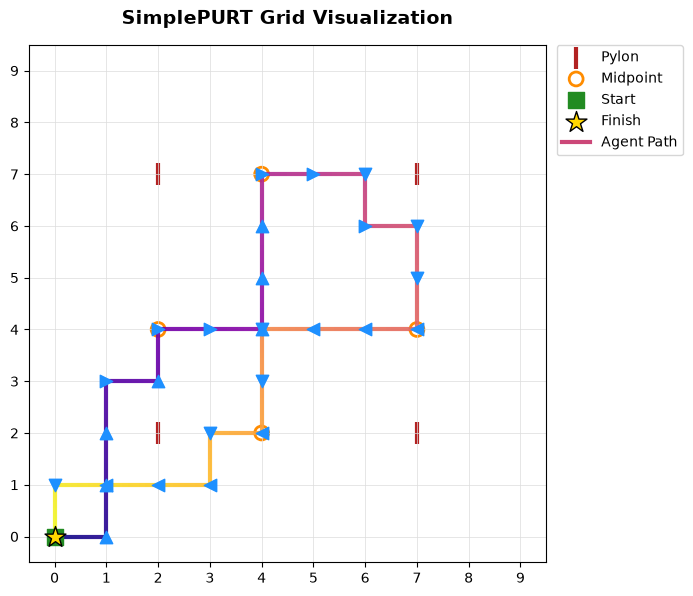
Policy Iteration completed in 18 iterations.
# Value iteration visualization
VI_env = SimplePURT(GRID_N=10)
VI_policy, VI_V, VI_n_iter = value_iteration(VI_env, discount_factor=0.9, theta=0.1)
print(f"Value Iteration completed in {VI_n_iter} sweeps.")
test_policy(VI_env, VI_policy)
Value Iteration completed in 16 sweeps.
# Reward analysis by outer loop and time

import time

REWARD_CONFIGS = {
    "Balanced":                         {"neutral": -1,   "midpoint": 10, "endpoint": 10,   "pylon": -10},
    "Big Endpoint Bonus":               {"neutral": -1,   "midpoint": 10, "endpoint": 1000, "pylon": -10},
    "Avoid Pylon":                      {"neutral": -1,   "midpoint": 1,  "endpoint": 10,   "pylon": -100},
    "Sparse":                           {"neutral": 0,    "midpoint": 0,  "endpoint": 1,    "pylon": -1},
    "Small Step Penalty":               {"neutral": -0.1, "midpoint": 1,  "endpoint": 1,    "pylon": -1},
    "Huge":                             {"neutral": -1, "midpoint": 10000,  "endpoint": 10000,    "pylon": -10000},

}

def compare_pi_vi(config_name, rewards, grid_n=10, discount_factor=0.9, theta=0.1):
    # Run Policy Iteration
    PI_env = SimplePURT(GRID_N=grid_n, REWARDS=rewards)
    t0 = time.perf_counter()
    PI_policy, PI_V, PI_n_iter = policy_iteration(PI_env, discount_factor=discount_factor, theta=theta)
    PI_time = time.perf_counter() - t0

    # Run Value Iteration
    VI_env = SimplePURT(GRID_N=grid_n, REWARDS=rewards)
    t0 = time.perf_counter()
    VI_policy, VI_V, VI_n_iter = value_iteration(VI_env, discount_factor=discount_factor, theta=theta)
    VI_time = time.perf_counter() - t0

    # Render both resulting policies side-by-side in one figure
    fig, axes = plt.subplots(1, 2, figsize=(15, 10))
    test_policy(PI_env, PI_policy, ax=axes[0], title=f"Policy Iteration  ({PI_n_iter} iterations)", legend_outside=False)
    test_policy(VI_env, VI_policy, ax=axes[1], title=f"Value Iteration  ({VI_n_iter} sweeps)", legend_outside=False)

    reward_str = ", ".join(f"{k}={v}" for k, v in rewards.items())
    fig.suptitle(f"{config_name}\nREWARDS: {{{reward_str}}}", fontsize=13, fontweight='bold')
    plt.tight_layout()
    plt.show()

    print("=" * 78)
    print(f"REWARD CONFIG : {config_name}")
    print(f"REWARDS       : {rewards}")
    print(f"  {'':24}{'Policy Iteration':>20}{'Value Iteration':>20}")
    print(f"  {'Outer loop count':24}{PI_n_iter:>20}{VI_n_iter:>20}")
    print(f"  {'Time (ms)':24}{PI_time*1000:>20.2f}{VI_time*1000:>20.2f}")
    print("=" * 78 + "\n")

    return {
        "rewards": rewards,
        "PI_policy": PI_policy, "PI_V": PI_V, "PI_n_iter": PI_n_iter, "PI_time": PI_time,
        "VI_policy": VI_policy, "VI_V": VI_V, "VI_n_iter": VI_n_iter, "VI_time": VI_time,
    }

results = {}
for name, rewards in REWARD_CONFIGS.items():
    results[name] = compare_pi_vi(name, rewards)

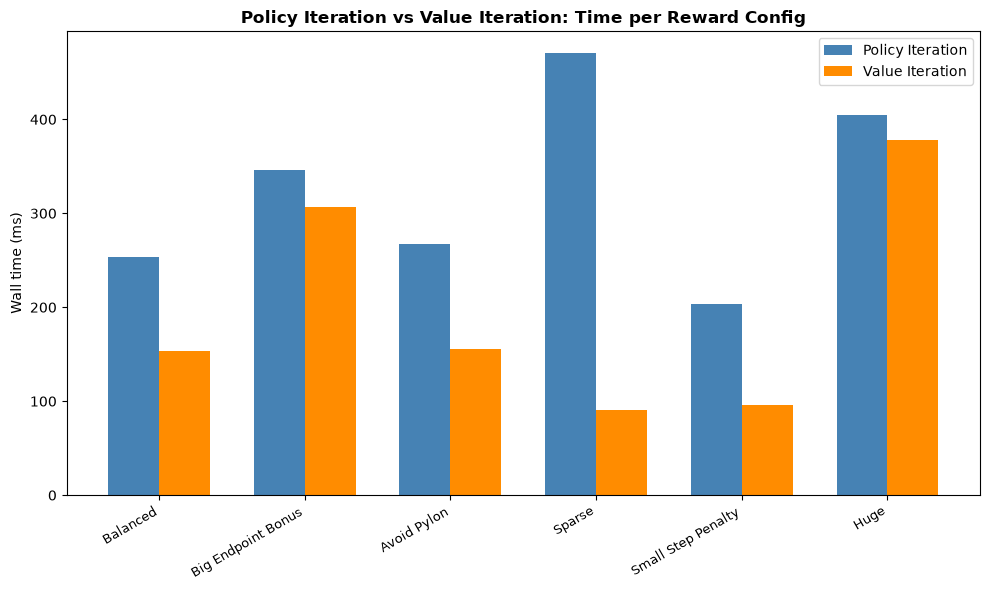
# --- New comparison graph: how long PI vs VI take, for every reward config, in one chart ---
config_names = list(results.keys())
pi_time_ms = [results[c]["PI_time"] * 1000 for c in config_names]
vi_time_ms = [results[c]["VI_time"] * 1000 for c in config_names]

x = np.arange(len(config_names))
width = 0.35

fig, ax = plt.subplots(figsize=(10, 6))
ax.bar(x - width/2, pi_time_ms, width, label='Policy Iteration', color='steelblue')
ax.bar(x + width/2, vi_time_ms, width, label='Value Iteration', color='darkorange')
ax.set_ylabel('Wall time (ms)')
ax.set_title('Policy Iteration vs Value Iteration: Time per Reward Config', fontweight='bold')
ax.set_xticks(x)
ax.set_xticklabels(config_names, rotation=30, ha='right', fontsize=9)
ax.legend()
plt.tight_layout()
plt.show()

# --- Animation: agent rollout with live cumulative reward, PI vs VI side-by-side ---
from matplotlib.animation import FuncAnimation
from IPython.display import HTML, display

def rollout_with_rewards(env, policy):
    """Runs the greedy policy once and records the reward received at every step.
    (env.state_history / env.action_history are already tracked by the env itself.)"""
    env.reset()
    rewards = [0.0]  # aligns with state_history[0]: no reward has been earned yet at the start
    while True:
        observation, reward, done, truncated, info = env.step(policy[env.state[0], env.state[1]])
        rewards.append(reward)
        if done or truncated:
            break
    return rewards


def animate_pi_vi_rollout(config_name, rewards_config, PI_policy, VI_policy, grid_n=10, interval=200):
    """Builds one synchronized animation of the PI and VI greedy rollouts side-by-side:
    the agent moving through the grid on top, and its cumulative reward over steps below.
    Reuses already-solved policies rather than re-running planning."""
    PI_env = SimplePURT(GRID_N=grid_n, REWARDS=rewards_config)
    PI_rewards = np.cumsum(rollout_with_rewards(PI_env, PI_policy))
    PI_path_x = np.array([s[0] % grid_n for s in PI_env.state_history])
    PI_path_y = np.array([s[0] // grid_n for s in PI_env.state_history])

    VI_env = SimplePURT(GRID_N=grid_n, REWARDS=rewards_config)
    VI_rewards = np.cumsum(rollout_with_rewards(VI_env, VI_policy))
    VI_path_x = np.array([s[0] % grid_n for s in VI_env.state_history])
    VI_path_y = np.array([s[0] // grid_n for s in VI_env.state_history])

    n_frames = max(len(PI_path_x), len(VI_path_x))

    fig, axes = plt.subplots(2, 2, figsize=(14, 9), gridspec_kw={'height_ratios': [3, 1]})
    ax_grid_pi, ax_grid_vi = axes[0]
    ax_rew_pi, ax_rew_vi = axes[1]

    def setup_grid_ax(ax, env, sub_title):
        ax.set_xlim(-0.5, grid_n - 0.5)
        ax.set_ylim(-0.5, grid_n - 0.5)
        ax.set_xticks(np.arange(grid_n))
        ax.set_yticks(np.arange(grid_n))
        ax.grid(True, color='gainsboro', linewidth=0.5)
        ax.set_aspect('equal')
        px, py = env.PYLON_GRID_COORDINATES[:, 0], env.PYLON_GRID_COORDINATES[:, 1]
        ax.scatter(px, py, color='firebrick', marker='|', s=200, linewidths=3, label='Pylon')
        mx, my = env.PYLON_MIDPOINT_GRID_COORDINATES[:, 0], env.PYLON_MIDPOINT_GRID_COORDINATES[:, 1]
        ax.scatter(mx, my, color='darkorange', marker='o', s=80, facecolors='none', edgecolors='darkorange', linewidths=2, label='Midpoint')
        ax.set_title(sub_title, fontweight='bold')
        ax.legend(loc='upper right', fontsize=7)

    setup_grid_ax(ax_grid_pi, PI_env, "Policy Iteration")
    setup_grid_ax(ax_grid_vi, VI_env, "Value Iteration")

    pi_line, = ax_grid_pi.plot([], [], color='dodgerblue', linewidth=2.5, zorder=2)
    pi_agent = ax_grid_pi.scatter([], [], color='forestgreen', s=140, zorder=3, edgecolor='black')
    vi_line, = ax_grid_vi.plot([], [], color='dodgerblue', linewidth=2.5, zorder=2)
    vi_agent = ax_grid_vi.scatter([], [], color='forestgreen', s=140, zorder=3, edgecolor='black')

    for ax, cum_reward in [(ax_rew_pi, PI_rewards), (ax_rew_vi, VI_rewards)]:
        ax.set_xlim(0, n_frames)
        ax.set_ylim(min(0, cum_reward.min()) - 1, max(0, cum_reward.max()) + 1)
        ax.axhline(0, color='gray', linewidth=0.7)
        ax.set_xlabel('Step')
        ax.set_ylabel('Cumulative Reward')

    pi_reward_line, = ax_rew_pi.plot([], [], color='steelblue', linewidth=2)
    vi_reward_line, = ax_rew_vi.plot([], [], color='darkorange', linewidth=2)

    reward_str = ", ".join(f"{k}={v}" for k, v in rewards_config.items())
    fig.suptitle(f"{config_name} — Rollout Animation\nREWARDS: {{{reward_str}}}", fontsize=13, fontweight='bold')

    def update(frame):
        pi_i = min(frame, len(PI_path_x) - 1)
        vi_i = min(frame, len(VI_path_x) - 1)

        pi_line.set_data(PI_path_x[:pi_i + 1], PI_path_y[:pi_i + 1])
        pi_agent.set_offsets([[PI_path_x[pi_i], PI_path_y[pi_i]]])
        pi_reward_line.set_data(np.arange(pi_i + 1), PI_rewards[:pi_i + 1])
        ax_rew_pi.set_title(f"PI cumulative reward: {PI_rewards[pi_i]:.1f}", fontsize=9)

        vi_line.set_data(VI_path_x[:vi_i + 1], VI_path_y[:vi_i + 1])
        vi_agent.set_offsets([[VI_path_x[vi_i], VI_path_y[vi_i]]])
        vi_reward_line.set_data(np.arange(vi_i + 1), VI_rewards[:vi_i + 1])
        ax_rew_vi.set_title(f"VI cumulative reward: {VI_rewards[vi_i]:.1f}", fontsize=9)

        return pi_line, pi_agent, pi_reward_line, vi_line, vi_agent, vi_reward_line

    anim = FuncAnimation(fig, update, frames=n_frames, interval=interval, blit=False, repeat=False)
    plt.close(fig)
    return anim

animation_config_name = "Balanced"
rollout_anim = animate_pi_vi_rollout(
    animation_config_name,
    REWARD_CONFIGS[animation_config_name],
    results[animation_config_name]["PI_policy"],
    results[animation_config_name]["VI_policy"],
)
display(HTML(rollout_anim.to_jshtml()))
==============================================================================
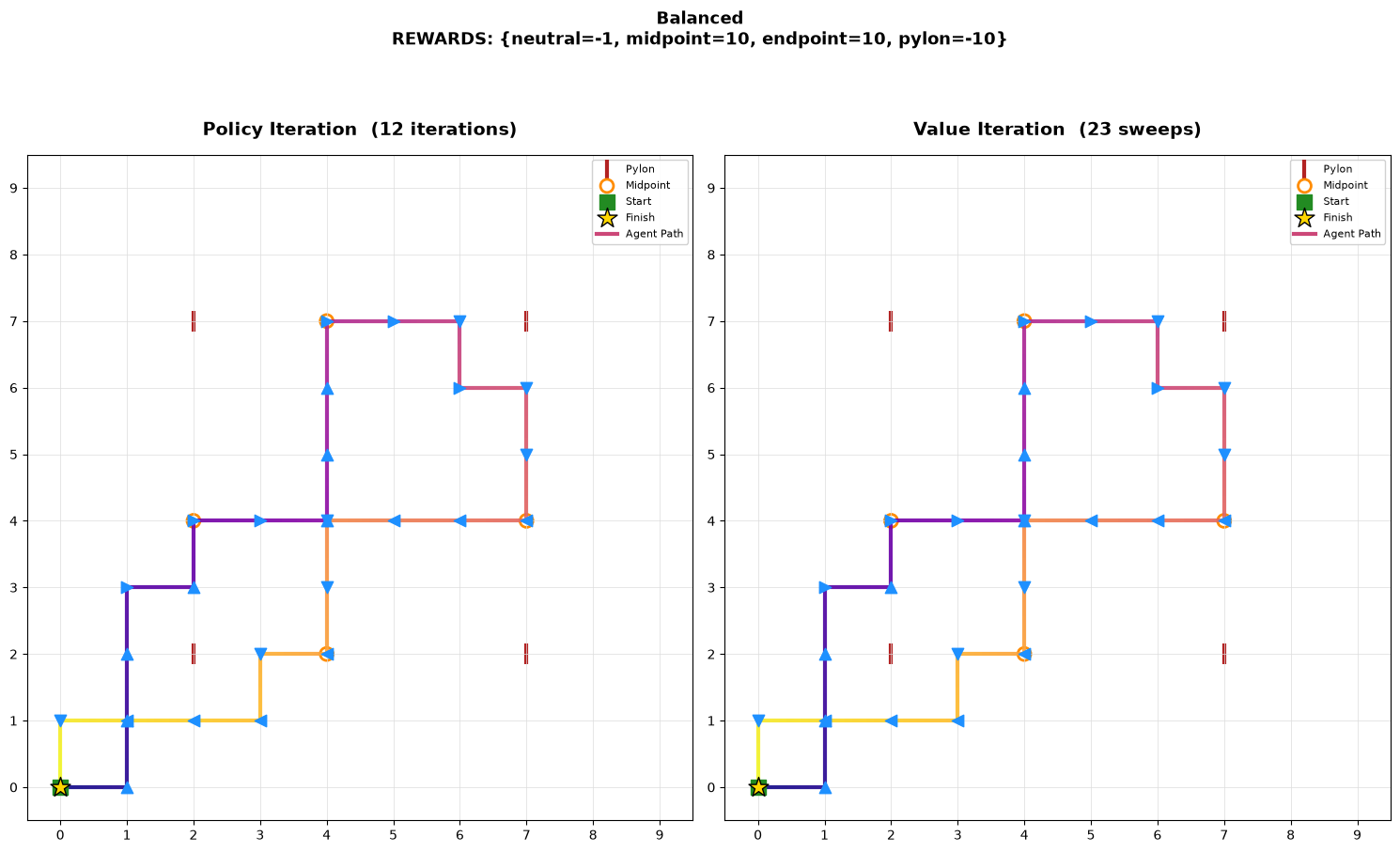
REWARD CONFIG : Balanced
REWARDS       : {'neutral': -1, 'midpoint': 10, 'endpoint': 10, 'pylon': -10}
                              Policy Iteration     Value Iteration
  Outer loop count                          12                  23
  Time (ms)                             253.66              153.57
==============================================================================
==============================================================================
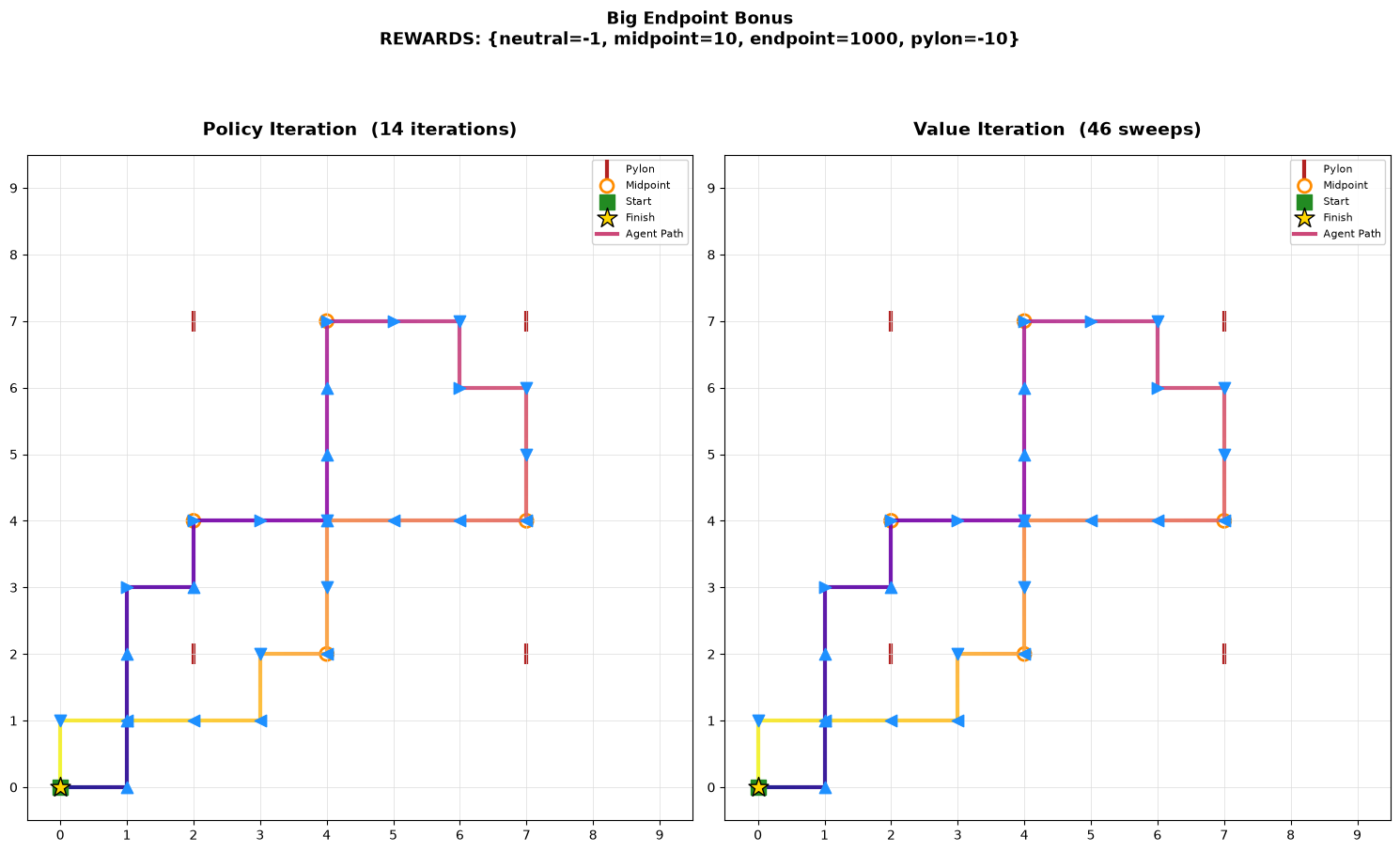
REWARD CONFIG : Big Endpoint Bonus
REWARDS       : {'neutral': -1, 'midpoint': 10, 'endpoint': 1000, 'pylon': -10}
                              Policy Iteration     Value Iteration
  Outer loop count                          14                  46
  Time (ms)                             346.12              307.26
==============================================================================
==============================================================================
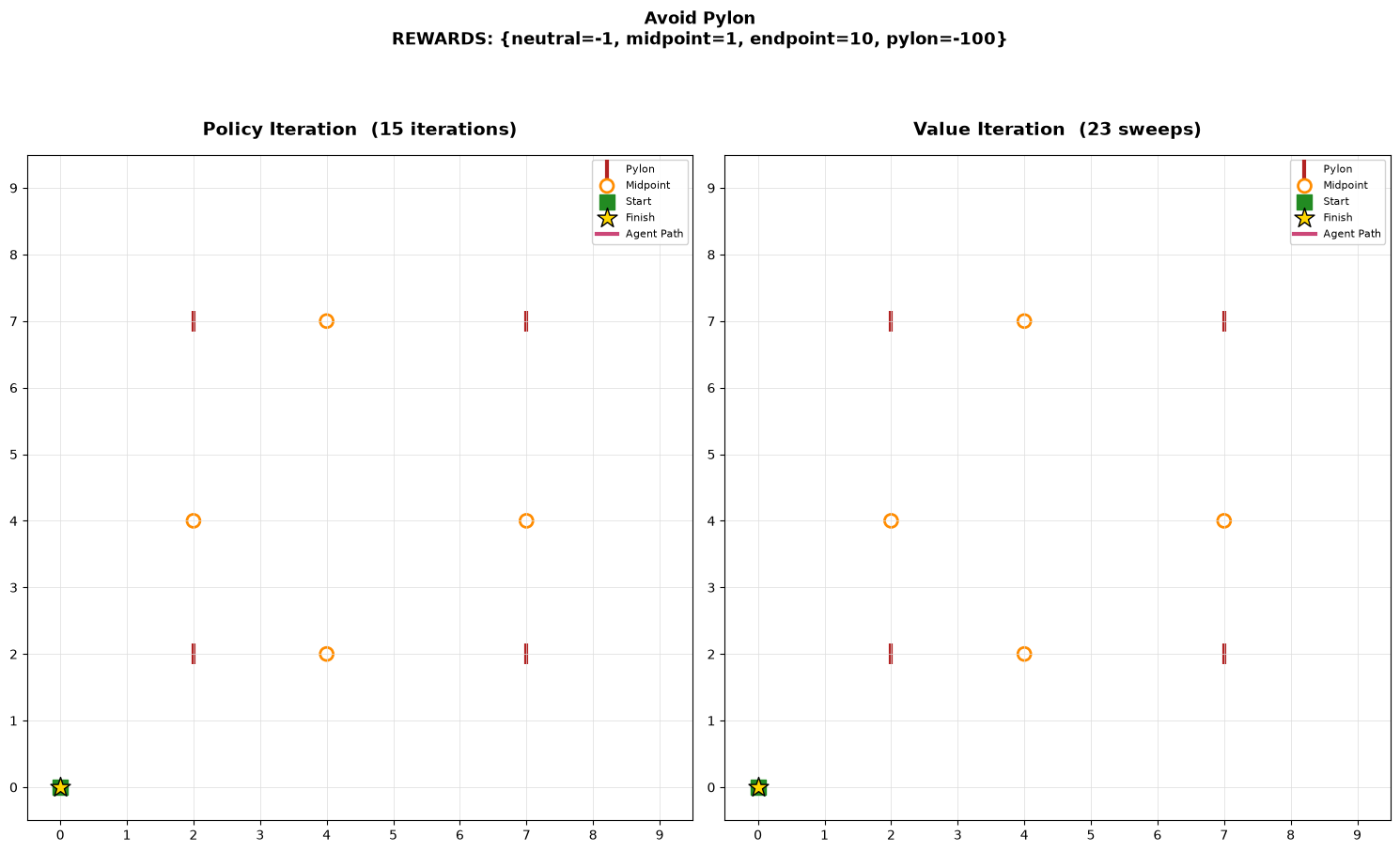
REWARD CONFIG : Avoid Pylon
REWARDS       : {'neutral': -1, 'midpoint': 1, 'endpoint': 10, 'pylon': -100}
                              Policy Iteration     Value Iteration
  Outer loop count                          15                  23
  Time (ms)                             266.90              155.27
==============================================================================
==============================================================================
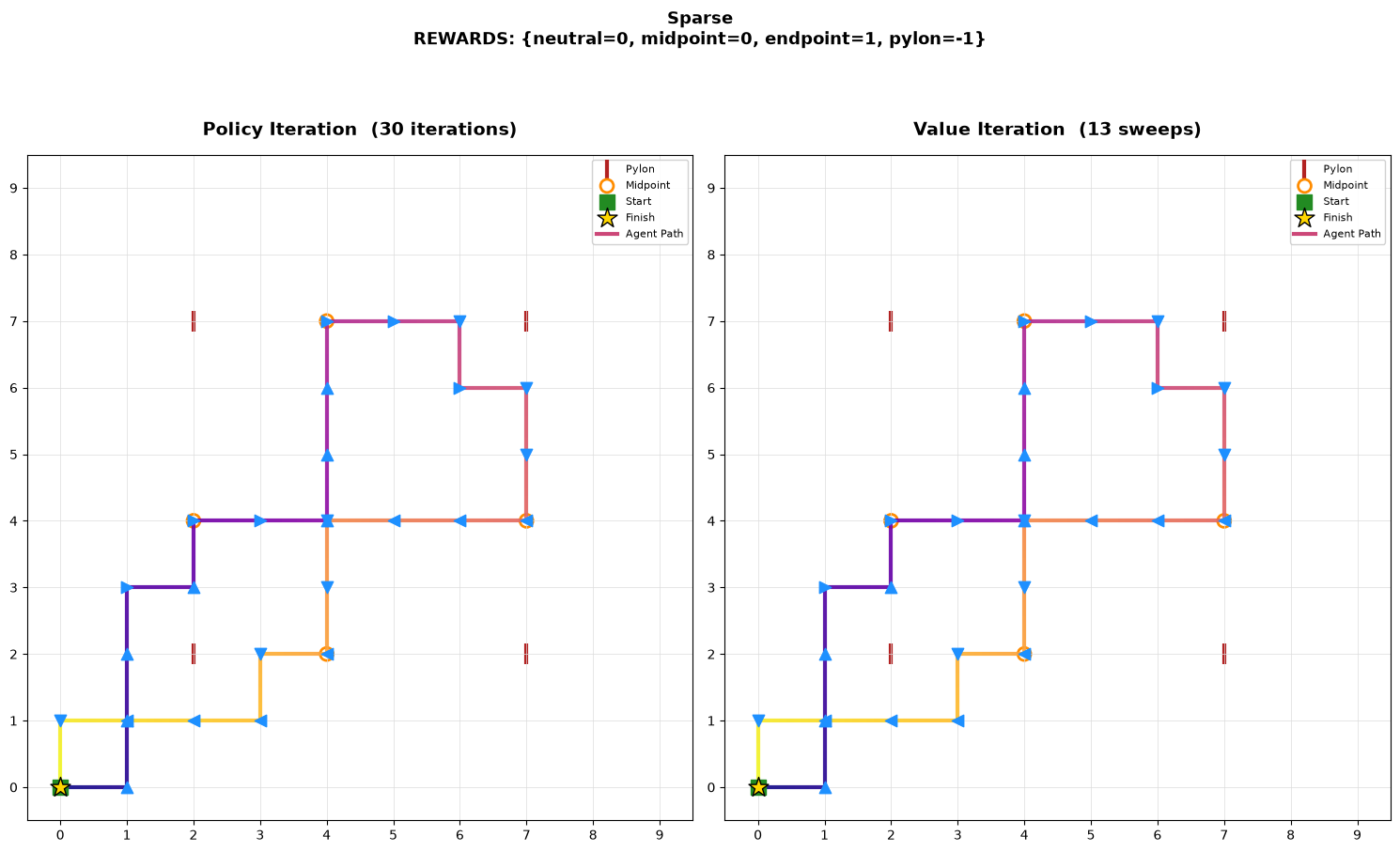
REWARD CONFIG : Sparse
REWARDS       : {'neutral': 0, 'midpoint': 0, 'endpoint': 1, 'pylon': -1}
                              Policy Iteration     Value Iteration
  Outer loop count                          30                  13
  Time (ms)                             470.21               91.06
==============================================================================
==============================================================================
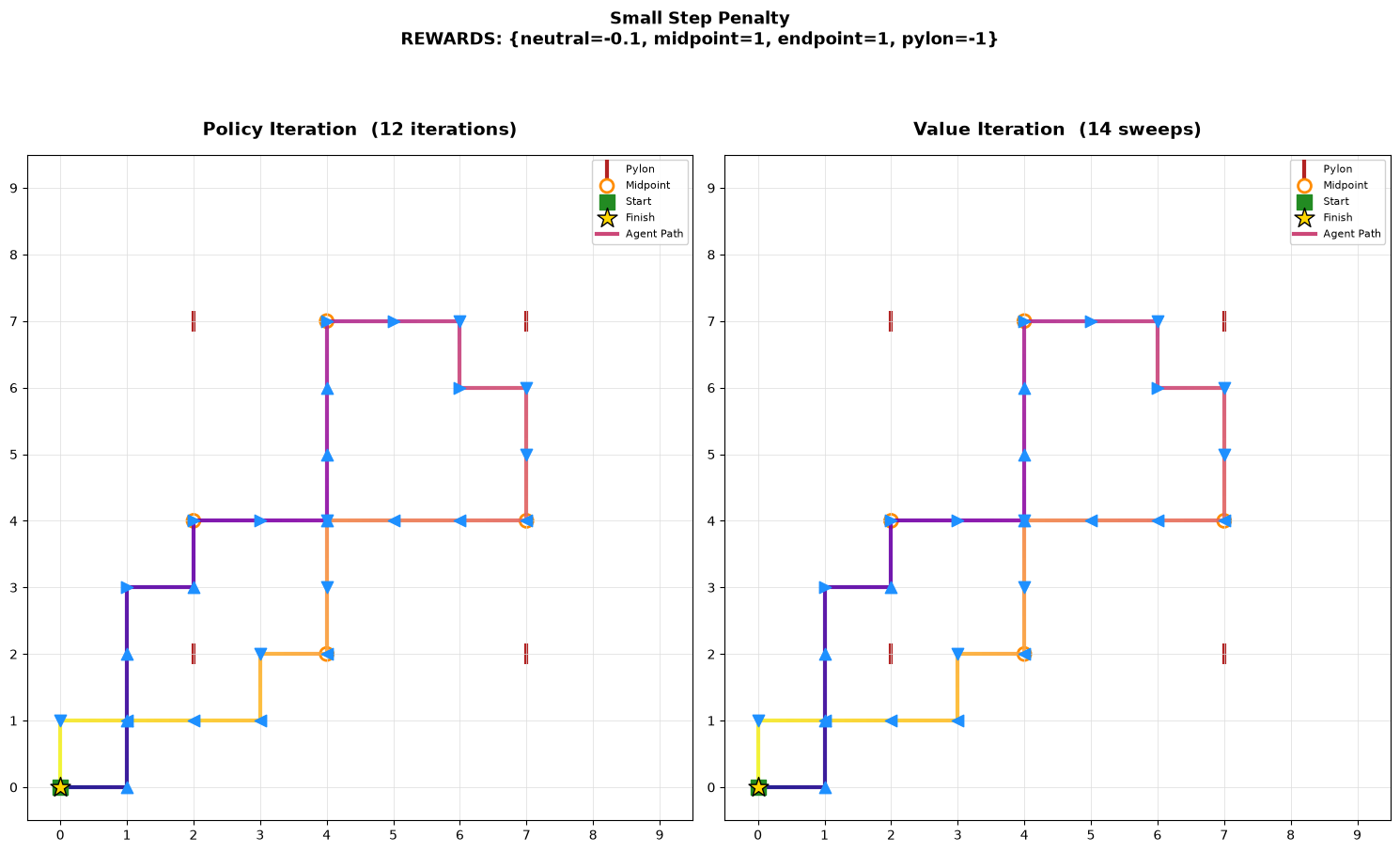
REWARD CONFIG : Small Step Penalty
REWARDS       : {'neutral': -0.1, 'midpoint': 1, 'endpoint': 1, 'pylon': -1}
                              Policy Iteration     Value Iteration
  Outer loop count                          12                  14
  Time (ms)                             203.45               95.63
==============================================================================
==============================================================================
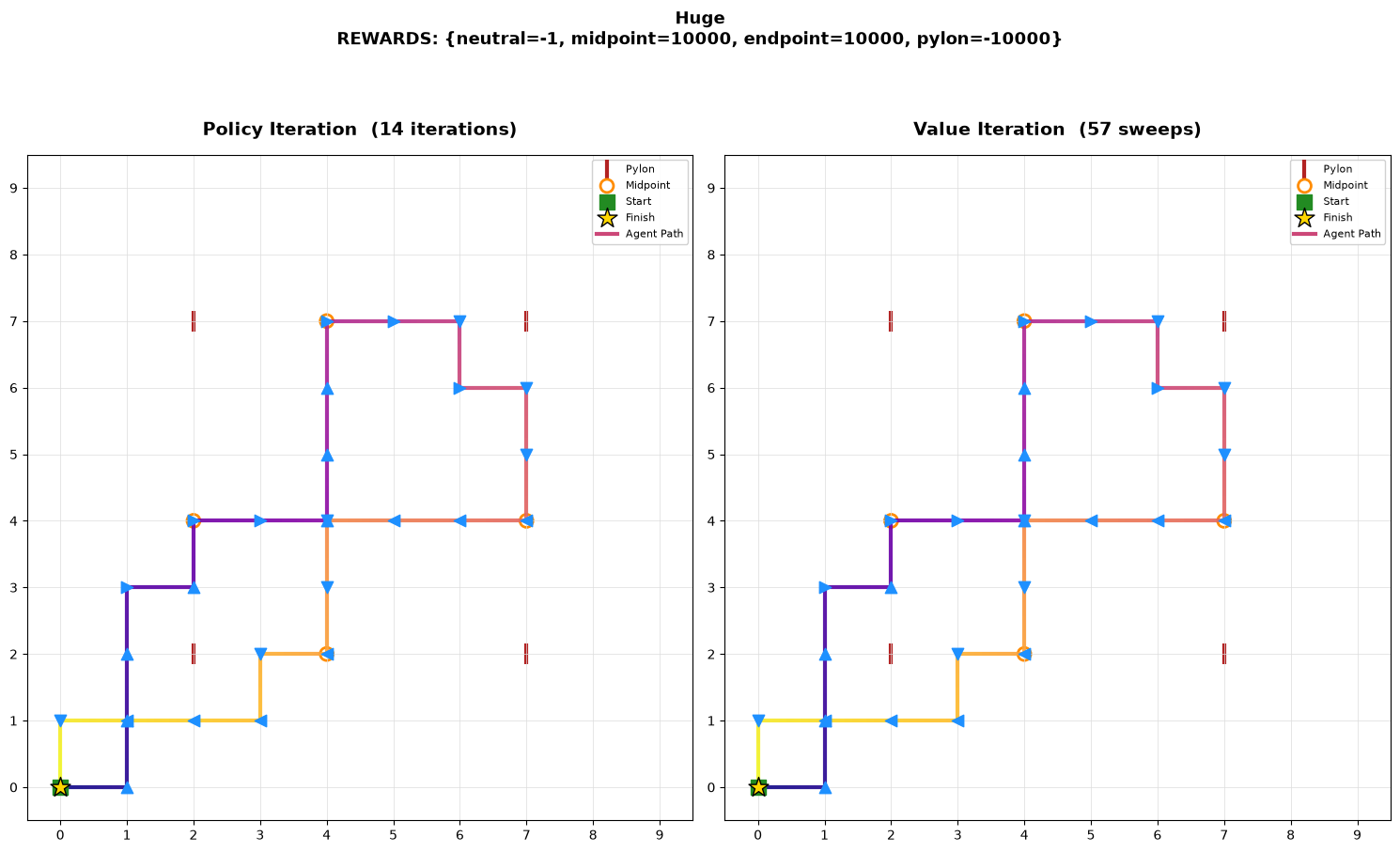
REWARD CONFIG : Huge
REWARDS       : {'neutral': -1, 'midpoint': 10000, 'endpoint': 10000, 'pylon': -10000}
                              Policy Iteration     Value Iteration
  Outer loop count                          14                  57
  Time (ms)                             404.16              377.67
==============================================================================
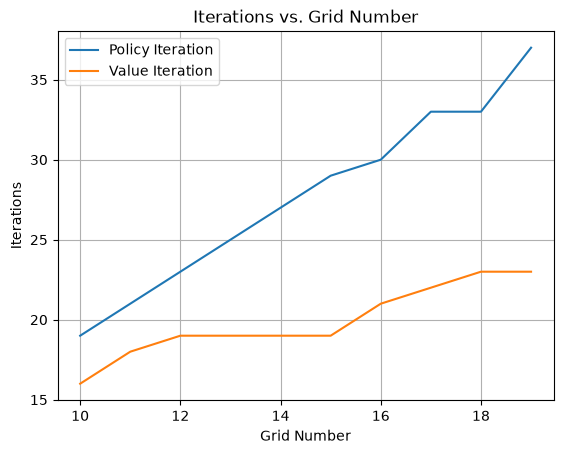
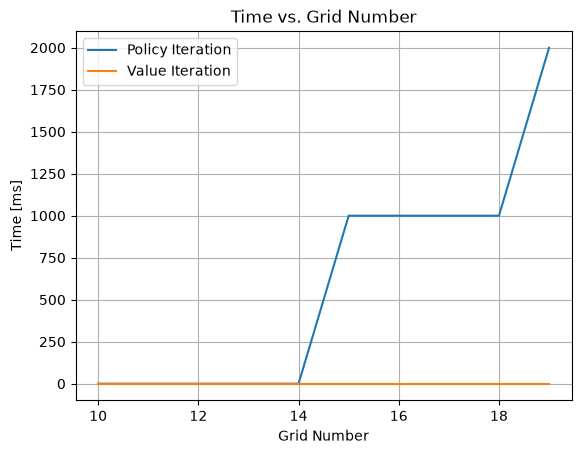
from tqdm import tqdm

# Grid Size

grid_range = range(10,20,1)
PI_n = np.zeros_like(grid_range)
VI_n = np.zeros_like(grid_range)
PI_t = np.zeros_like(grid_range)
VI_t = np.zeros_like(grid_range)

for i in tqdm(range(len(grid_range))):
    env = SimplePURT(GRID_N=grid_range[i])
    env.reset()
    pt0 = time.perf_counter()
    PI_policy, PI_V, PI_n_iter = policy_iteration(env, discount_factor=0.9, theta=0.1)
    pt1 = time.perf_counter()
    env.reset()
    vt0 = time.perf_counter()
    VI_policy, VI_V, VI_n_iter = value_iteration(env, discount_factor=0.9, theta=0.1)
    vt1 = time.perf_counter()
    PI_n[i] = PI_n_iter
    VI_n[i] = VI_n_iter
    PI_t[i] = pt1 - pt0
    VI_t[i] = vt1 - vt0

# Iterations vs. Grid Number
plt.plot(grid_range, PI_n, grid_range, VI_n)
plt.legend(["Policy Iteration", "Value Iteration"])
plt.xlabel("Grid Number")
plt.ylabel("Iterations")
plt.grid(True)
plt.title("Iterations vs. Grid Number")
plt.show()

# Time vs. Grid Number
plt.plot(grid_range, PI_t*1000, grid_range, VI_t*1000)
plt.legend(["Policy Iteration", "Value Iteration"])
plt.xlabel("Grid Number")
plt.ylabel("Time [ms]")
plt.grid(True)
plt.title("Time vs. Grid Number")
plt.show()
100%|██████████| 10/10 [00:14<00:00, 1.42s/it]
Noisy Environment#
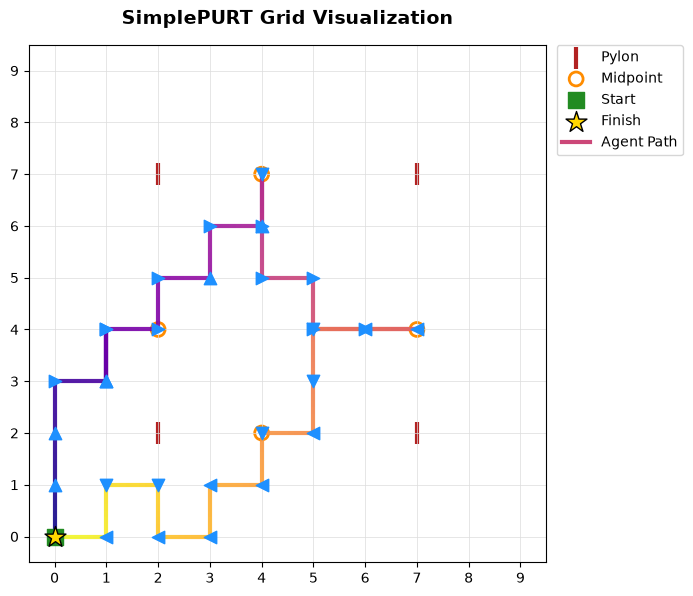
VI_policy, VI_V, VI_n_iter = value_iteration(SimplePURT(NOISE=0.25), discount_factor=0.9, theta=0.1)
Noise Resilient Policy in Noisy Environment#
test_policy(SimplePURT(NOISE=0.25),VI_policy)
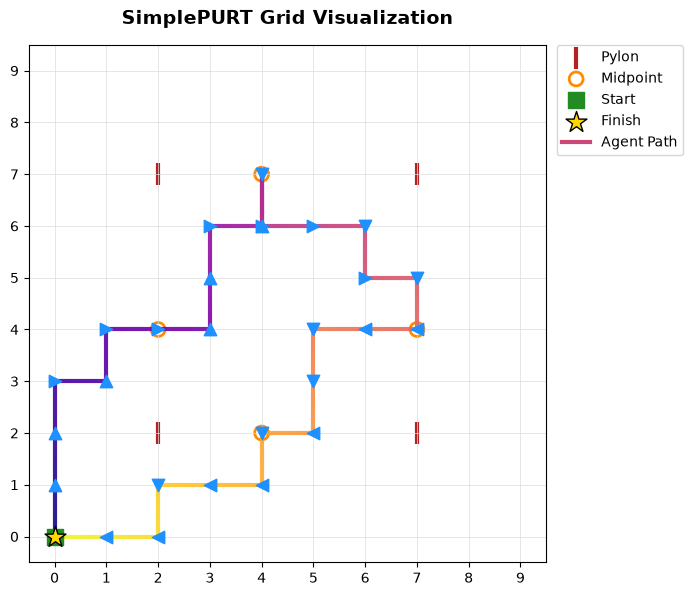
Noise Resilient Policy in Noiseless Environment#
test_policy(SimplePURT(NOISE=0),VI_policy)
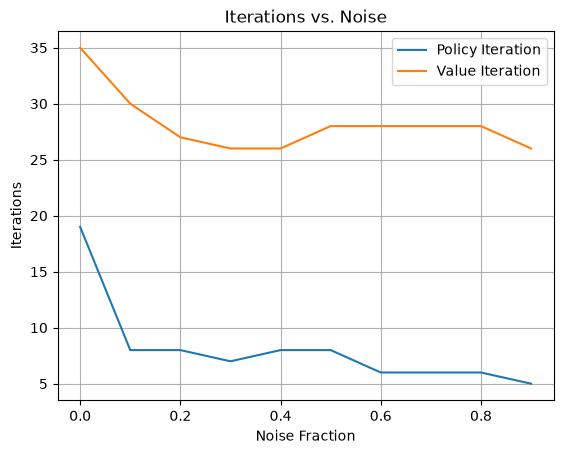
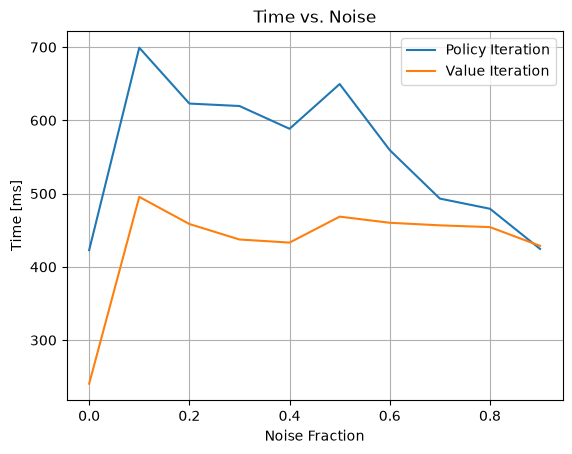
# Noise

noise_range = np.arange(0,1,0.1)
PI_n = np.zeros_like(noise_range)
VI_n = np.zeros_like(noise_range)
PI_t = np.zeros_like(noise_range)
VI_t = np.zeros_like(noise_range)

for i in tqdm(range(len(noise_range))):
    env = SimplePURT(NOISE=noise_range[i])
    env.reset()
    pt0 = time.perf_counter()
    PI_policy, PI_V, PI_n_iter = policy_iteration(env, discount_factor=0.9, theta=0.001)
    pt1 = time.perf_counter()
    env.reset()
    vt0 = time.perf_counter()
    VI_policy, VI_V, VI_n_iter = value_iteration(env, discount_factor=0.9, theta=0.001)
    vt1 = time.perf_counter()
    PI_n[i] = PI_n_iter
    VI_n[i] = VI_n_iter
    PI_t[i] = pt1 - pt0
    VI_t[i] = vt1 - vt0

# Iterations vs. Noise
plt.plot(noise_range, PI_n, noise_range, VI_n)
plt.legend(["Policy Iteration", "Value Iteration"])
plt.xlabel("Noise Fraction")
plt.ylabel("Iterations")
plt.grid(True)
plt.title("Iterations vs. Noise")
plt.show()

# Time vs. Noise
plt.plot(noise_range, PI_t*1000, noise_range, VI_t*1000)
plt.legend(["Policy Iteration", "Value Iteration"])
plt.xlabel("Noise Fraction")
plt.ylabel("Time [ms]")
plt.grid(True)
plt.title("Time vs. Noise")
plt.show()
100%|██████████| 10/10 [00:09<00:00, 1.01it/s]